Operating principle of Overflow Valve
What is the overflow valve?
Overflow valves are used in conditions where it is necessary to quickly supply a large amount of water for firefighting and are therefore often an indispensable part in fire-fighting systems.
The overflow system provides large amounts of water to a large area in a short period of time. They are commonly used in fixed systems where the pipe system is empty until the overflow valve supplies pressurized water to the system when the sprinklers or nozzles automatically open.

The overflow valve is used to quickly supply water to sprinkler systems. Overflow valves protect areas such as transformer stations, storage tanks, conveyors or other industrial structures. Added with air bubble systems, they can protect hangars and flammable storage areas.
Also Read: Deluge Valve Transformer Protection Animation
Overflow Valve Operation
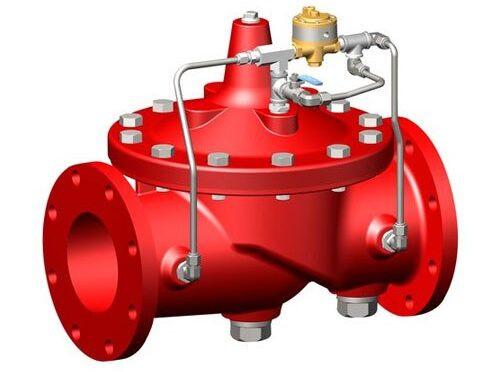
The overflow valve is a type of quick-response, hydraulically operated diaphragm valve. Consists of three separate compartments separated by diaphragms and valve leaflets.
When the valve is in the 'SET' position, water pressure is transmitted through the external one-way valve and trigger pipe from the supply side of the system to the chamber on the top of the valve. This pressure affects the diaphragm that holds the valve leaf tightly, helping the valve close due to the pressure difference between the chambers.
When a fire occurs, the top chamber of the valve is open to the atmosphere through broken nozzle(s) or open nozzle. The top chamber pressure is not sufficiently replenished through the manifold, so the pressure drop is less than half that of the inlet pressure and the upward force of the inlet pressure lifts the valve leaf allowing water to enter the system's pipe network and alarm devices.

Types of overflow valves
a) Basic components of valve
Are the basic components of the overflow valve regardless of opening and closing form. Includes components needed in all installations such as relief valves, main connection pipes, check valves, emergency relief valves and pressure gauges.
b) Gas-activated overflow valve
The valve's activation system is connected to a closed nozzle system containing compressed air, located in the area to be protected. It requires a steady supply of dry compressed air connected to the valve's actuation hose. The pipeline is directly connected to the PDA (POSITIVE DRAIN ACTUATOR). The bottom of the PDA unit is connected to the top chamber of the overflow valve.
When the gas pressure is reduced by any component of the system, the PDA's diaphragm is raised and allows water to flow through. This reduces the water pressure on the top chamber of the overflow valve and when the pressure of the top chamber drops to 50% of the inlet pressure, the overflow valve will open.
The direct discharge process of the PDA unit will begin when the pressure of the top chamber reaches about 0.5kg/cm2. This active flushing will prevent the overflow valve from closing, unless the PDA is reset.
c) Water-activated overflow valve
The water-activated system uses a trigger pipe connected to a water-filled closed sprinkler fire suppression system.
When the nozzle breaks or the nozzle is opened, the water pressure in the top chamber of the overflow valve decreases to 50% of the inlet pressure, the overflow valve will open.
d) Electrically activated overflow valve
To activate an electrical overflow valve, a solenoid valve is used to discharge water in the top chamber of the overflow valve. A flow switch is used to activate the fire alarm system, turn off necessary equipment when an incident occurs or display a "Tripped" signal on the control cabinet.
In addition, a 2-level pressure switch can be used to display the "Low air pressure" and "Fire status" signals when using a dry system.
e) Alarm and inspection system
This system includes an alarm, which operates based on the activation of the overflow valve. A check valve is installed to check the operating condition of the alarm.
Also Read: Deluge Valve Operation Types
Application of Overflow Valve
The overflow system is used in conditions where a large amount of water needs to be supplied at a rapid rate. They create a "buffer zone" in dangerous areas or areas where a fire could spread quickly. They can also be used to cool surfaces to prevent deformation or collapse of the structure. Or to protect tanks, transformers or technology lines from fire and explosion.
Some other applications: tanks containing flammable chemicals, warehouses or production areas containing substances with low flash points, or product handling systems.
Advantages and disadvantages of the overflow valve system
Advantages
- The entire fire area is flooded with water, helping to extinguish the fire as quickly as possible and avoid future damage.
- Ability to react very quickly
- Damage caused by fire is minimal because the area near the fire is cooled by a large amount of water and its ability to The ability to spread fire is no longer significant.
- Cost is cheaper than other methods
Disadvantages
- May cause damage to electronic components or fragile equipment.
- Longer cleaning time compared to other systems
- Requires a large amount of water reserve for operation.
Source: https://instrumentationtools.com/deluge-valve-working-principle/
Abridged translation: Khanh An