Rethink air distribution in HVAC systems
AUTHOR: JOEL ERWAY
Different ventilation techniques can help make people happier and make buildings more environmentally friendly.
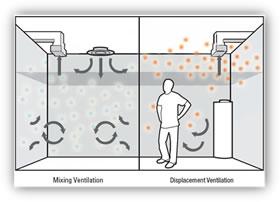
The most common form of air supply in the HVAC system is air mixing at high altitude. In most buildings such as offices, schools or hospitals, you can observe air diffusers (called vents) blowing temperature-controlled air into the room.
These devices use high pressure to blow heat-treated air into the room space, mixing with the air in the room to increase or reduce heat. However, this technology is not without its problems. In this method of air mixing, pollutants can still remain in the space, which can cause the air quality in the room to decrease. In addition, air vents are usually placed 8-12 feet (2.5 - 3.5m) above the foundation. This height means that the energy transferred to heat or cool also includes unused spaces (not very "green").
But energy and HVAC engineers are constantly researching and exploring so there are more effective, higher performance and cleaner ways to handle the temperature of a room space.
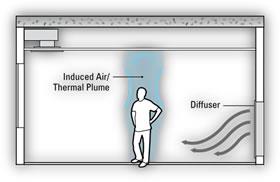
An increasingly popular alternative method, called stream ventilation, where air is blown at a slow speed through larger vents located close to ground level that "sweep" across the room. This conditioned air then moves naturally to heat sources or people throughout the room. This is due to the fact that heat moves air, and because the human body naturally produces heat, conditioned air will naturally flow to and cool our bodies.
When conditioned air penetrates into the space, the air in the room will be pushed upward and discharged from the room through air intakes located high above. The air will not mix so pollutants will be removed.
What does this method mean?
- Uses less energy because only the used space needs to be cooled, not the unused space above.
- Uses less energy because lower wind speeds will require fans with lower capacity.
- Users will feel comfortable because less air circulation is felt.
- The air is unmixed, which means that potential pollutants in the space will not mix with each other.
These technological changes appear more and more frequently in the "Air Conditioning and Ventilation" industry as we are always pushing things in a "greener" direction. The question that is always asked is: What's next?
Source: https://www.engineering.com/story/re-thinking-air-distribution-with-hvac
Brief translation: Khanh An