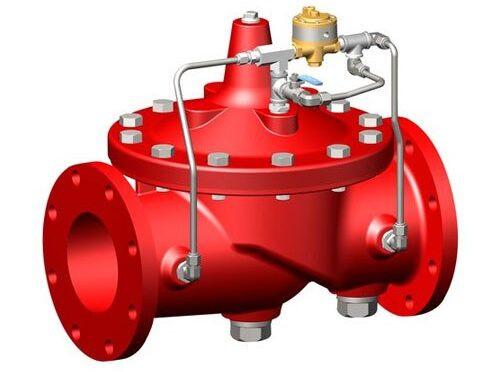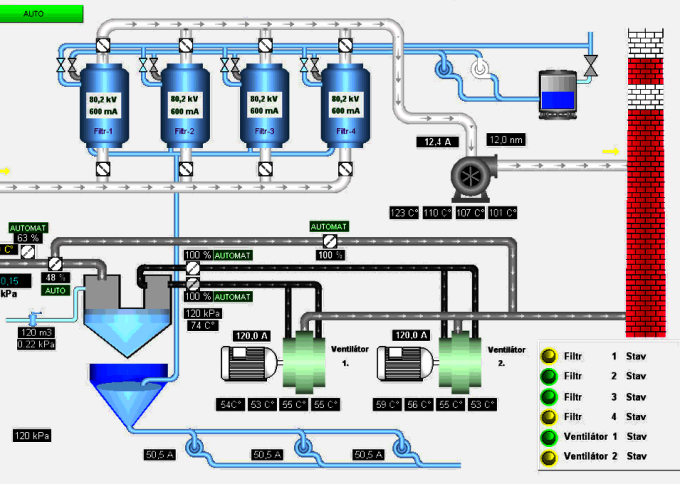
Overview of different types of valves
The important function of a valve is to close, open or regulate the flow of fluid. Regulating means adjusting and controlling the flow of a fluid (Illustration below).
Different types of valves

1. Globe valve - Globe valve
Globe valves are widely used in industry for both opening/closing and flow control. They often have a spherical body like their name.
They are linear flow valves with a disc or cone shaped part mounted on a valve shaft. This part will cover a point shaped corresponding to the above disc or plug, to control the flow (Illustration below)
The fluid flow will have to change direction by 90° twice when flowing through the valve. For that reason, the pressure loss of a globe valve is very significant even when the valve is fully open. High pressure loss is the main disadvantage of globe valves.

2. Gate valves - Gate valves
Gate valve is mainly used for opening and closing function but can also be used as a regulating valve. It is a linear flow valve with a flat disc or wedge that slides into the fluid flow to regulate the fluid flow (Illustration below).
Fluid flow does not change when flowing through the valve. When the valve is fully open, the valve leaf will be completely removed from the flow, causing minimal pressure loss.
Gate valves have an advantage in applications involving sludge, as their 'gate' can cut right through the sludge. They are also used in applications involving highly viscous fluids such as heavy oils, light greases, varnishes, molasses, honey and creams.

3. Needle valves
Needle valve is used when it is necessary to adjust the flow relatively finely. They are used both to open/close and regulate traffic
It is a linear flow valve, with an "almost needle" tapered plug that regulates flow.
The needle-shaped button allows to gradually increase or decrease the flow through the valve. Needle valves are widely used for systems such as steam, air, gas, water or low viscosity liquids.
The disadvantage of needle valve is that it has large pressure loss and is easily clogged.

4. Pinch valves
The membrane pressed valve is quite inexpensive, is the simplest valve of all and can be used both to open/close and regulate fluid.
Diaphragm valve is a linear valve that uses a flexible tube inside the valve to close the valve.
Diaphragm valve is an ideal valve for use in systems containing sludge, liquids with large amounts of suspended solids or corrosive chemicals.

5. Diaphragm valves
Diaphragm valve is similar to the Pinch valve and is one of the oldest types of valves known. Diaphragm valves made of leather were used by the Greeks and Romans to control the temperature of hot tubs.
Diaphragm valve uses up and down motion of the valve shaft to open and close or regulate flow and is an excellent valve application for liquids containing suspended solids.
A plug moves a stretchable membrane stopper into the flow to regulate the flow. Diaphragm valves are mainly used for liquids with high viscosity and containing corrosive ingredients as well as sludge.

6. Button valve - Plug valves
Button valve (also known as cock valve) is also a type of valve that dates back to ancient times, when the Romans used them for water supply and drainage systems.
Today they are still one of the most widely used valves both for opening/closing and regulating flow. A button valve is a type of rotary valve that uses a shaft or a conical plug to control flow.
On the shaft body there is a rectangular or round opening. Fluid flows through the valve through the hole in the shaft when the shaft rotates 90°. If the opening on the shaft body is equal to or larger than the inside diameter of the tube, it is called a full opening or standard round opening.
A fully open valve will have a smaller pressure loss when the valve is open. The disadvantage of the button valve is its poor flow regulation feature.

7. Valve Ball - Ball valves
Ball valve is similar to a button valve. When the system requires a tightly closed valve, a ball valve will be used. The valve is a rotary valve and is used for both opening/closing and flow regulation functions. The flow regulator is a spherical block with an opening on the body, this sphere can rotate in a fixed position.
Flow is formed when the valve switches from closed to open by turning a 90° angle. In the fully open state, the valve will have very small pressure loss. The disadvantage of the button valve is its poor flow regulation feature.

8. Butterfly valve - Butterfly valves
Butterfly valve is a type of rotary valve used to open/close and especially to regulate flow. The flow regulator of the butterfly valve is a circular disc with a perpendicular axis to the flow direction.
When rotating the shaft 90°, the valve will change state from closed to open. Butterfly valves are suitable for liquid or gas systems with large flow rates as well as slurries or liquids with suspended solid objects.

Source: https://instrumentationtools.com/short-notes-different-valve-types/
Abridged translation: Khanh An